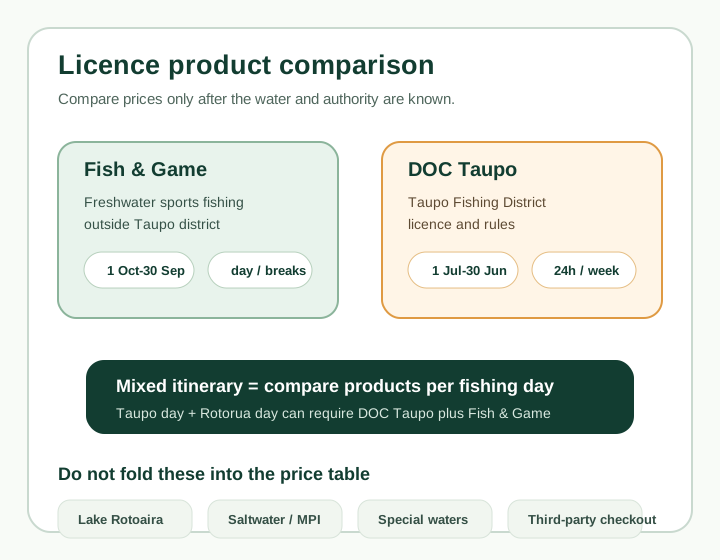
Non-resident day vs season licence math is useful only after the water is confirmed as Fish & Game freshwater outside Taupo. Current Fish & Game examples put a non-resident adult one-day licence at NZ$38 and the whole-season non-resident adult licence at NZ$270, but the calculation must exclude Taupo, Lake Rotoaira, saltwater, and any special-water rule that changes eligibility.
Status gate before the maths
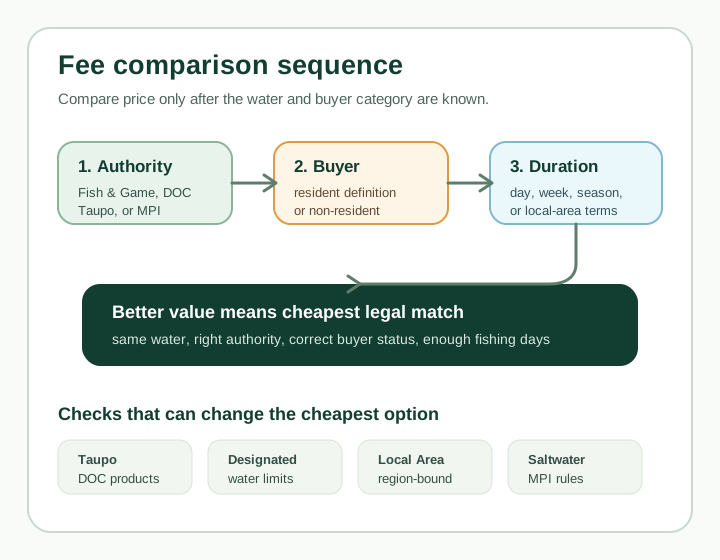
Fish & Game's non-resident path is for anglers who do not meet its resident definition and who are fishing Fish & Game freshwater outside the Taupo Fishing District. Do not start with the cheaper resident price, and do not count DOC Taupo days just because the traveller is from overseas.
| Gate | Why it matters before the break-even |
|---|---|
| Buyer status | A visitor who is not ordinarily resident should not choose a resident Fish & Game product |
| Water authority | Fish & Game non-resident licences do not cover Taupo, Lake Rotoaira, or saltwater |
| Actual fishing days | Count fishing days, not hotel nights, travel days, or sightseeing days |
| Special-water status | Designated Waters and controlled fisheries can override the simple day-product plan |
| Regional rules | A valid licence still needs the current regional notice for season, method, bag, and access |
If status or water is uncertain, solve that first. The non-resident licence guide handles buyer status, while Fish & Game vs DOC Taupo handles the authority split.
Count only Fish & Game non-resident days
The comparison is intentionally narrow. It answers one question: how many actual Fish & Game fishing days make a non-resident whole-season licence better value than repeated non-resident one-day licences?
| Count in the break-even | Do not count here |
|---|---|
| Trout or salmon days in Fish & Game regions outside Taupo | Taupo Fishing District days |
| Fish & Game days in more than one region | Lake Rotoaira days |
| Return trips inside the same Fish & Game licence year | Recreational sea-fishing days |
| Fish & Game days where the non-resident category is correct | Sightseeing, travel, or non-fishing days |
If the trip is still a mixed itinerary, classify the water first. The tourist fishing licence guide is the better starting point when the plan includes Taupo, Rotorua, the South Island, beaches, charters, and short freshwater sessions in one holiday.
The Fish & Game whole-season year is a separate calendar from DOC Taupo's 1 July to 30 June Taupo year. A visitor returning to New Zealand later in the same Fish & Game season should include those Fish & Game days in the comparison, but only if the water is still inside the Fish & Game system.
Adult break-even
For a non-resident adult, the whole-season licence starts to make price sense from the eighth Fish & Game fishing day.
| Non-resident adult Fish & Game days | One-day total at NZ$38 | Planning result |
|---|---|---|
| 1 | NZ$38 | One-day licence is cheaper if the day is fixed and valid for the water |
| 3 | NZ$114 | Repeated one-day licences are still cheaper than the season product |
| 7 | NZ$266 | Still NZ$4 below the NZ$270 whole-season product |
| 8 | NZ$304 | Whole-season product is NZ$34 cheaper than repeated one-day licences |
That is a price threshold, not a licence shortcut. The whole-season product can also be cleaner when the visitor may shift fishing days because of weather, river flows, guiding availability, or return travel during the same Fish & Game season.
The formula is simple: divide the whole-season price by the one-day price, then round up to the next whole fishing day. For the current adult examples, NZ$270 divided by NZ$38 is just over seven days, so the first day where the season product beats repeated one-day products is day eight.
There are two practical exceptions. First, a visitor who values flexibility may still choose a season product before day eight. Second, a designated-water or controlled-fishery requirement can make the ordinary one-day product unusable even when the trip is only one day.
Junior and child break-even
Fish & Game's current non-resident junior or child examples use NZ$23 for one day and NZ$51 for whole season. The integer break-even arrives much earlier.
| Non-resident junior or child Fish & Game days | One-day total at NZ$23 | Planning result |
|---|---|---|
| 1 | NZ$23 | One-day product is cheaper |
| 2 | NZ$46 | Still NZ$5 below the NZ$51 whole-season product |
| 3 | NZ$69 | Whole-season product is NZ$18 cheaper than repeated one-day licences |
Families travelling with children should check the age category carefully before copying the adult break-even. The family, child, and junior licence guide separates Fish & Game, Taupo, Rotoaira, and saltwater category language.
The same rounding logic applies here: NZ$51 divided by NZ$23 is more than two one-day licences, so the third Fish & Game day is where the whole-season product starts to win on price. That does not mean every child in a mixed itinerary needs this Fish & Game product; Taupo, Rotoaira, and saltwater still sit outside the calculation.
Designated Waters change the answer
Designated Waters are the main reason the cheapest one-day calculation can be wrong. Fish & Game says a one-day non-resident licence does not allow fishing in a Designated Waters Fishery. For non-residents, the designated-water path starts with a qualifying whole-season non-resident licence, then adds the required Designated Waters day access where the official page requires it.
That means a single premium or special-water day can make the one-day-versus-season arithmetic irrelevant. Before buying a visitor day product, check the Designated Waters licence guide and any named-water page such as Upper Rangitikei or Upper Oreti.
Controlled fisheries are separate from Designated Waters, but they create the same planning warning: price comparison is not enough. If a named fishery requires a booking, allocation, receipt, named angler, controlled period, or special access condition, solve that workflow before buying the cheapest non-resident day product.
| Special-water signal | What to do before using the day-price table |
|---|---|
| Upper Rangitikei or Upper Oreti | Open the designated-water page and check the non-resident whole-season requirement |
| Greenstone or Ohau controlled fishery | Open the controlled-fishery page and confirm the current booking or allocation workflow |
| Upper Hurunui | Check both controlled-fishery and Designated Waters language before comparing prices |
| Remote backcountry guide booking | Ask for the exact official water name, then verify the current Fish & Game source |
Taupo, Rotoaira, and saltwater are outside this calculation
Taupo is managed by DOC, not Fish & Game. A non-resident Fish & Game day or season licence does not become a Taupo 24-hour, week, or season licence. Lake Rotoaira is a separate DOC licence and regulation check again.
Saltwater is not a Fish & Game non-resident duration purchase. A coast-only fishing day belongs to MPI marine rules, not this break-even table. Mixed holidays should be split by authority before money is spent.
| Itinerary component | Where to send that decision |
|---|---|
| Taupo Fishing District | Taupo licence guide |
| Lake Rotoaira | Lake Rotoaira guide |
| Beaches, harbours, or sea charters | Freshwater vs saltwater guide |
| Fish & Game visitor days outside Taupo | This break-even plus the non-resident licence guide |
If a holiday has two Taupo days and six Fish & Game days, the Fish & Game adult season product has not reached the price break-even. Count six Fish & Game days here, then price Taupo through DOC. If the same trip has one Upper Oreti day, the Designated Waters rule may change the answer even though the Fish & Game day count is low.
Example visitor trips
| Visitor plan | Better reading of the break-even |
|---|---|
| One guided trout day near Rotorua | One-day non-resident Fish & Game licence can fit if the water is not designated |
| Four Fish & Game days split across two regions | Repeated adult day licences remain cheaper, but flexibility may matter |
| Eight Fish & Game days over a longer holiday | Adult whole-season non-resident licence starts to beat repeated day products |
| Three child fishing days in Fish & Game water | Non-resident junior or child whole-season product can beat repeated day products |
| One Fish & Game day plus two Taupo days | Count only the Fish & Game day here; price Taupo through DOC |
| One designated-water day | Check the whole-season plus Designated Waters path before comparing day products |
| Seven Fish & Game days with no special water | Adult repeated day licences remain slightly cheaper, but flexibility may justify the season product |
| Six Fish & Game days plus one later return trip inside the same Fish & Game year | Count all seven Fish & Game days if the later trip is real |
| Two Fish & Game days plus a controlled fishery | Confirm the controlled-fishery terms before assuming two one-day products are enough |
For broader resident, Taupo, short-break, long-break, winter, and saltwater duration choices, use the day vs season fishing licence comparison as the next comparison.
Purchase-path safeguards
The calculation should end at the official Fish & Game purchase path, not at a note in an itinerary. Before paying, confirm the buyer's name, non-resident status, date, product, water, and any special-water condition. If a guide, lodge, friend, or agent is helping with the purchase, ask for proof of the actual licence product, not just confirmation that "a licence is sorted".
Old summaries can be especially risky near 1 October, when the Fish & Game season cycle changes. Reopen Fish & Game's current non-resident page and regional regulations before relying on a saved price, saved PDF, or previous-year receipt.
Before buying
Confirm the angler is correctly treated as non-resident, name the exact Fish & Game water, count only actual Fish & Game fishing days, and check whether any designated-water or controlled-fishery condition changes the product. Then confirm the current fee in the official Fish & Game purchase path before paying.
The useful answer is not simply day or season. It is the cheapest valid Fish & Game non-resident product that still fits the person, water, date, and special-water rules.