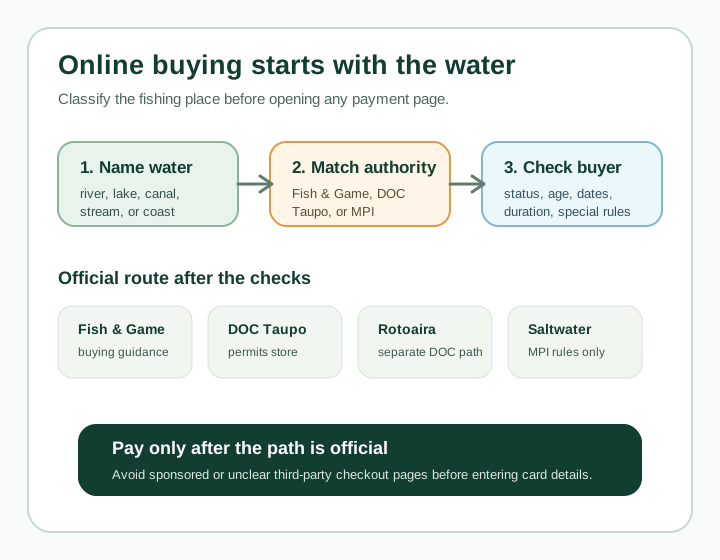
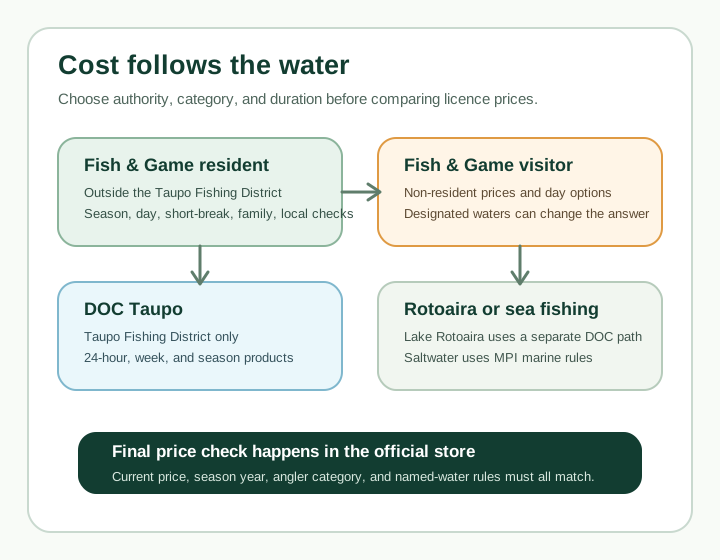
A New Zealand visitor licence decision should start with status and water, not price. If you are not ordinarily resident in New Zealand and you plan to fish for sports fish in Fish & Game freshwater outside Taupo, the Fish & Game non-resident licence path is the one to check. If the trip is Taupo, Lake Rotoaira, saltwater, or a designated water, the answer changes before cost becomes useful.
First decide whether this is a non-resident Fish & Game trip
The non-resident licence applies to people who are not ordinary residents in New Zealand and who are fishing Fish & Game freshwater sports-fish waters outside the Taupo Fishing District. Fish & Game tests resident or non-resident status against the relevant 1 October season date, so a visa, temporary stay, working-holiday plan, study period, or physical arrival in New Zealand should not be treated as resident status by itself. Fish & Game treats fishing with the wrong licence category as a serious error, so do not choose a resident product just because it is cheaper or because the trip is short.
Use the visitor decision in this order:
| Question | If yes | If no |
|---|---|---|
| Are you not ordinarily resident in New Zealand? | Continue with non-resident Fish & Game checks | Check the resident Fish & Game guide instead |
| Are you fishing Fish & Game freshwater outside Taupo? | Compare one-day, whole-season, and special-water needs | Use DOC or MPI depending on the water |
| Is the planned water a Designated Water or controlled fishery? | Check the whole-season and designated-water path before buying | A day or whole-season non-resident product may be enough |
| Will the trip cross regions or include several fishing days? | Compare whole-season value and regional notices | A one-day product may fit a single Fish & Game day |
That sequence prevents the common visitor mistake: comparing prices before identifying the authority.
Foreigners, visitors, and tourists: which term matters?
Search results often use "tourist licence", "foreigner fishing licence", and "visitor licence" as loose phrases. They are useful signals for intent, but they are not the product name to choose in every New Zealand checkout.
| Search wording | Use it to mean | Do not use it to mean |
|---|---|---|
| Foreigner fishing licence | A person from overseas may need the Fish & Game non-resident path | Every non-New-Zealand trip uses the same licence |
| Tourist fishing licence | The itinerary needs water-by-water sorting | There is one tourist product for Fish & Game, Taupo, Rotoaira, and sea |
| Visitor fishing licence | A broad synonym that should be mapped to the authority and status first | An official product category that replaces non-resident wording |
| Non-resident Fish & Game licence | The official Fish & Game visitor product family outside Taupo | A DOC Taupo, Lake Rotoaira, or marine-fishing rule answer |
If the trip is still a holiday route rather than a Fish & Game product decision, use the tourist fishing licence guide. If the product is already Fish & Game non-resident and the question is price, use the licence cost guide or the non-resident day vs season break-even instead of widening this page into a full fee table.
Where a non-resident Fish & Game licence works
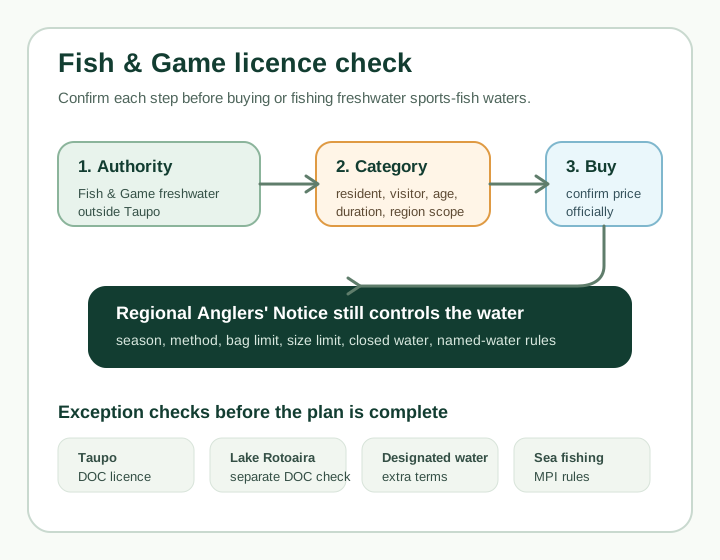
A non-resident Fish & Game licence is for sports fishing in Fish & Game regions outside the Taupo Fishing District. It does not replace regional rules. The current regional Anglers' Notice still controls the water, season, method, bag limit, size limit, closed water, and any named-water condition.
| Trip component | Licence and rule path |
|---|---|
| Trout or salmon in a Fish & Game region outside Taupo | Non-resident Fish & Game licence plus the regional notice |
| Taupo Fishing District | DOC Taupo licence and DOC Taupo rules |
| Lake Rotoaira | Separate DOC Lake Rotoaira licence and regulations |
| Recreational sea fishing | MPI recreational marine rules, not Fish & Game |
| Designated Waters Fishery | Non-resident whole-season licence plus the required designated-water day licence path |
| Controlled fishery | Whole-season licence and controlled-fishery terms before fishing |
If the water classification is still unclear, use the licence decision guide or the saltwater and freshwater comparison before buying.
If the trip is still a tourist itinerary rather than a Fish & Game product decision, start with the tourist fishing licence guide and return here only for the Fish & Game non-resident part.
Choosing one day or whole season
The fee table above gives the current non-resident products listed here, but it should not drive the decision by itself. Choose by actual Fish & Game freshwater days, region movement, flexibility, and whether any special-water requirement changes the product.
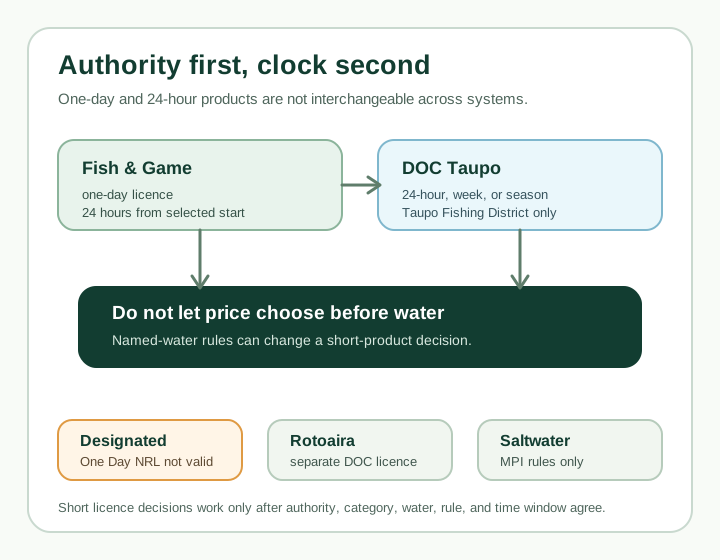
A one-day non-resident licence can fit a single Fish & Game freshwater session outside Taupo, especially when the rest of the holiday is sightseeing or sea fishing. It is a poor fit if weather may shift the fishing day, if the trip might expand into multiple freshwater days, or if the planned water is a Designated Waters Fishery.
A whole-season non-resident licence becomes more relevant when the visitor will fish multiple Fish & Game days, cross more than one Fish & Game region, return later in the same season, or needs the qualifying licence for Designated Waters or a controlled fishery.
Do not substitute resident Short Break, Long Break, Winter, Local Area, family, or senior products for a non-resident trip because the name or duration looks convenient. Fish & Game's non-resident guidance keeps visitor products separate, and the official store is the place to confirm the current category before payment.
For short-product planning, use the one-day and 24-hour licence guide before paying. It separates Fish & Game non-resident day products from DOC Taupo 24-hour products. For the narrow visitor price threshold, see the non-resident day vs season break-even. For the broader day-vs-season calculation, use the day vs season comparison. For visitor children or family groups, check the family, child, and junior licence guide before assuming the adult visitor rule covers everyone.
Designated waters and controlled fisheries
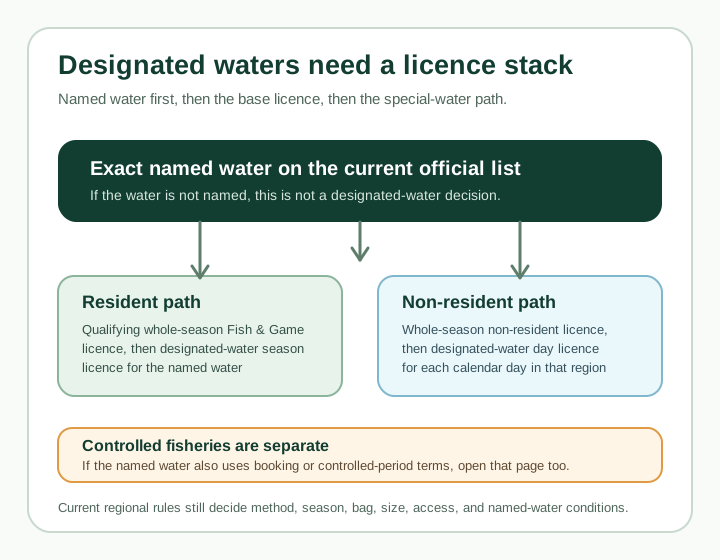
Designated Waters are not an ordinary one-day visitor purchase. Fish & Game states that the one-day non-resident licence does not allow fishing in a Designated Waters Fishery. For non-resident anglers, the designated-water path requires a non-resident whole-season licence first, then a Designated Waters Day Licence for the day or days fished on the designated water.
The Designated Waters Day Licence is a calendar-day decision, not a flexible 24-hour shortcut. Fish & Game's current designated-water guidance also limits an angler to a maximum of five designated-water days in a Fish & Game region. If this page mentions prices in trip planning, treat the current NZ$40 designated-water day example as a store-check item rather than a substitute for the official page.
This matters for backcountry and pressure-sensitive fisheries, especially in South Island travel plans. Do not rely on broad route labels such as "South Island trout" or "guided backcountry day". Identify the exact river, lake, or fishery, then check whether the regional notice, designated-water page, or controlled-fishery terms add another step.
If the target water is designated, use the Designated Waters licence guide before assuming a non-resident day licence is enough. Named examples such as Upper Rangitikei and Upper Oreti show why the exact reach matters before price. For ordinary Southland river planning, the Mataura River guide shows how a non-designated river can still need reach-specific rule checks.
| Visitor special-water question | Is a base Fish & Game licence enough? | Is a non-resident one-day product enough? | Extra official-check path |
|---|---|---|---|
| Designated Waters | No; use the qualifying whole-season path first | No | Designated Waters licence guide and Fish & Game Designated Waters source |
| Controlled fishery | Official check; the base licence does not replace booking or allocation terms | No for controlled-fishery access assumptions | Controlled fishery page for the named water plus Fish & Game controlled-fishery source |
| Sea-run salmon | Official check; base licence can be only one layer | Official check | North Canterbury sea-run salmon guide plus current Fish & Game salmon source |
Taupo, Lake Rotoaira, and saltwater are separate decisions
Taupo is outside Fish & Game coverage. A visitor fishing the Taupo Fishing District needs the DOC Taupo licence path, not a Fish & Game non-resident licence. Lake Rotoaira also needs its own DOC check because DOC treats it separately from the Taupo Fishing District.
Saltwater is a different system again. Recreational sea fishing around New Zealand does not use the Fish & Game sports-fishing licence system, but MPI rules still control fishery areas, limits, legal sizes, methods, closed areas, shellfish, and other marine requirements.
For mixed itineraries, treat each fishing day by water and authority. A Rotorua trout day can point to Fish & Game Eastern; a Lake Taupo day points to DOC; a coast-only day points to MPI.
Visitor itinerary examples
| Visitor plan | Better licence decision |
|---|---|
| One guided trout day near Rotorua | Fish & Game non-resident day licence if the water is not Taupo and not a designated water |
| Rotorua plus Lake Taupo | Fish & Game for the Rotorua water; DOC Taupo for Taupo district water |
| South Island backcountry trout | Check whether the exact water is a Designated Waters Fishery before choosing day or season |
| Canterbury salmon and trout | Fish & Game non-resident licence plus regional notice, sea-run salmon, and any controlled-fishery check |
| Auckland beach plus Waikato trout stream | MPI for the beach; Fish & Game non-resident licence and Auckland/Waikato notice for the trout stream |
| Lake Rotoaira only | DOC Lake Rotoaira licence and regulations, not Fish & Game |
These examples are not shortcuts around the official rules. They show the order of analysis: status, authority, water, licence category, regional notice, and special conditions.
Buying before travel
Buy through the official Fish & Game online system or an authorised licence agent after the trip has been classified. Fish & Game also describes purchase options for overseas visitors who want a licence arranged before arrival; allow enough time if a posted licence is needed.
Before paying, confirm:
- The angler is correctly treated as non-resident or resident.
- The planned freshwater is in a Fish & Game region outside Taupo.
- The trip length supports one-day, whole-season, or another official non-resident product.
- The water is not a Designated Water, controlled fishery, or sea-run salmon situation needing an extra check.
- Every Fish & Game region on the itinerary has been checked against the current regional notice.
- Taupo, Lake Rotoaira, and saltwater days have been moved to their DOC or MPI rule paths.
If you are ready to buy online, use the online buying guide after confirming the licence category. If you want official agents or channel guidance, use the where to buy guide. For broader fee comparison, use the resident and non-resident fee comparison rather than duplicating calculations on this page.
Keep the proof as carefully as the payment receipt. Before fishing, confirm the licence holder name, product, non-resident category, dates, and Fish & Game water. Save the current regional rule page beside the licence proof, because the licence proves the purchase layer while the Anglers' Notice controls the fishing day.
Visitor purchase risks to resolve
Buying a resident licence because the visitor price is higher creates the clearest compliance risk. If Fish & Game treats the angler as non-resident, the resident category does not solve the licence problem.
Taupo creates a different kind of risk because it feels like ordinary trout water but sits outside Fish & Game coverage. Taupo and Lake Rotoaira must be checked through DOC.
Guided or hosted trips need their own confirmation too. A guide, lodge, charter, friend, or shop may help with planning, but each angler still needs the correct licence and must follow the regional rule for the water.
A one-day non-resident licence is also unsafe as a default for special water. Check the exact water before the cheapest or shortest licence becomes the plan.
For visitors, the professional decision is itinerary-led: identify the angler status, classify each water, separate Fish & Game from DOC and MPI, then buy the non-resident product only when the day, season, and special-water checks agree.